
Creativity: Supply vs. Demand
Creative people like to create – no surprise there. But most people who create things struggle to get anyone to care about their creations. Once you have made something good, the challenge is no longer creativity, but generating demand for what you make.
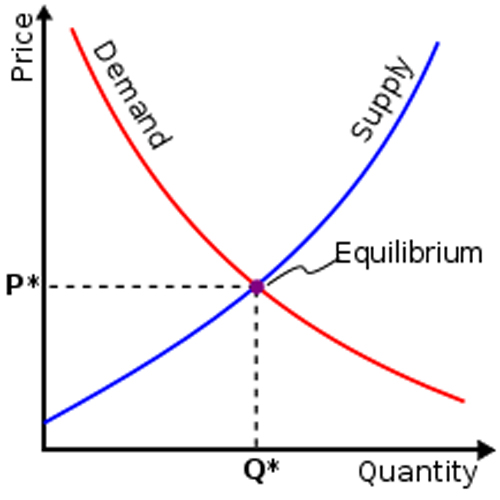
Every intro to economics course in the world pummels students with endless variations of curves, like the one above. Right now thousands of MBA students at colleges around the world are watching professors prance around and poke at charts with curves on them, and for good reason. There are basics of commerce that everyone should understand, even in the oversimplified way I’m about to describe.
The demand side of creativity
Assume you are in a market with more supply than demand: you have 20 widgets (or great ideas), but your customer (your boss) isn’t interested in paying much for them.
If we think of the chart there are three choices:
- Lower prices, expecting to increase sales.
- Create a new diagram, showing infinite demand, and staple it to your boss’ forehead.
- Work to increase reasons for demand.
It’s hard to do #1 if you have an employer. #2 is fun, but requires a fast stapler and good aim. Leaving #3. Something has to be done to shift that demand curve to the right.
So how does a creative person increase demand for their work?
- Ask. Mention to your customers you want to provide more value. What is it that drives their demand for your work? Ask the question and then shut-up and listen. They’re telling you their values, and if you want their demand you have to work on their turf. You might influence their values, but that’s a tough place to start.
- Persuade. The reason why your creative heroes became famous was more than their talent. They marketed themselves, or had friends and supporters who did the marketing for them. Your weakness might be your ability to sell yourself and persuade others on the value of your work.
- Tell stories. In your world, who has the strongest demand for your work? Even if you are unpopular, someone likes your work more than others. Tell their story to the rest of your market of why they find what you do valuable. Testimonials are everywhere in marketing for this reason: it demonstrates demand, which creates demand.
- Prove your value. Are there before and after pictures you can show? Stats on how your creations have helped sales, raised profits, lowered costs? Start compiling and when you have a good case, spread it around. Take an inventory of all the ideas and creations you’ve had: no matter how you’ve struggled, some efforts will have had more value than others.
- Take a a risk / Make a proposal. Once you have stories and proof of value, place a bet on yourself. Put a proposal together: a plan for a new project, a change in how an existing project should be done, something. The better the stories & proof, the more ambitious the proposal. Use those stories and proof of value as collateral, and as part of your pitch for a specific action you want. Imagine the kind of demand you feel your work is worthy of, and craft the proposal to match.
- Find a champion. Who has enough influence to raise demand for your work? Enlist them as your advocate. Explain the goal of raising the value of your work, and ask for help. Can they talk to their peers? Recommend you for projects? Or endorse a proposal you’ve made?
You get the idea – someone has to do marketing for your creations, and that’s a different skill, and philosophy, than creation itself. Often this is the role design managers or creative directors are supposed to play, but its rarely as much fun for them as working the supply side.
A more accurate discussion of how supply and demand curves work can be found at netmba or at wikipedia (where the diagram above is from).
Have other demand side activities that creatives can use? Let me know.
Hey Scott,
Just one comment. If the boss isn’t interested in paying more for ideas then a shift in demand due to marketing would be detrimental to your ability to sell ideas. The shift in demand must be accompanied with an increase in supply in order to keep the price stable. The ultimate outcome of these two shifts would be an increase in ideas sold.
Hi Mike!
How can you both increase supply and demand at the same time?
What I was trying to say, and perhaps I botched it, was that marketing yourself successfully would increase the perceived value of your work, increasing demand without any change in supply. Do u agree with that?
Really interesting post.