
Do constraints help creative thinking?
Can you be creative without constraints?
 It’s a tricky question. Creative people everywhere complain that they don’t have enough resources to be creative at work. In the lingo, “blue sky” refers to a project where the sky is the limit, and it’s the creative holy grail. “If only I could get a week to think blue sky, I could do amazing things”.
But one definition of creativity is the ability to transcend constraints. Dr. Seuss did some of his best work with the hardest constraints. To find a clever way out of a difficult situation, or use a new idea to make lack of resources an advantage. I think about the Ramones or the Sex Pistols, bands whose lack of training became an asset. Or Spike Lee & Richard Rodriguez, filmmakers whose first films cost less than the price of a new car.
It’s interesting to notice how big corporations, with enormous resources, often fail at being creative despite their blue sky budgets. Is there something in the nature of constraints that brings out the best creativity?
Constraints as a special tool. We think of them as rigid, but they’re flexible things. Constraints can be:
- interpreted differently
- intensified
- diminished
- created on purpose
- eliminated on purpose
Thinking like a manager, the goal is to have appropriate constraints that roughly match the goals. A team that is on life support needs to have constraints removed. But a team that is unfocused or out of control needs tighter constraints to function well.
Back in the 90s, Microsoft used to hire 3 people to do a project they knew required 5. Why? To create a set of constraints that self-motivated people would love. In trade for the extra work people received autonomy, and the net result was a creative, and productive, win.
Thinking like a individual, routines like writing an hour a day, or making a certain number of alternative designs, is a self imposed creative constraint to force my best work to surface, and in that sense I think everyone uses constraints in some way to help them be creative.
How do you use constraints in your creative work? Both at a personal level, but also at the project or team level?
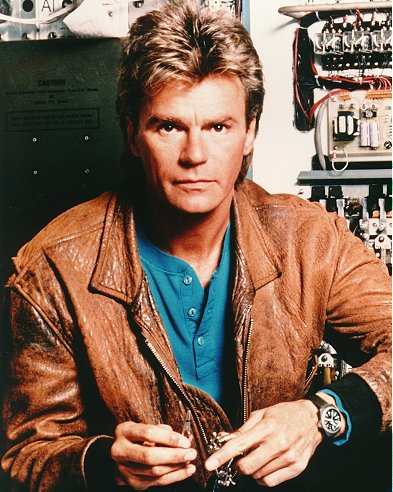
(MacGyver is the patron saint of creative constraints).
I agree with this post. Rarely do I participate in purely blue sky activities. There is always some constaint that ties in our ideas (usually the time to create them). Also because I work with execution teams to follow a vision that of course isn’t fully flushed out, I have to be creative in many approaches so that I can fit solutions in their timelines and budgets (most of the time it’s not a perfect fit :) ).
One of my favorite quotes from the famous composer Igor Stravinsky is this: “No matter what the subject be, there is only one course for the beginner; he must at first accept a discipline imposed from without, but only as the means ofobtaining freedom for, and strengthening himself in, his own method of expression.” He also said sometime to the effect that there’s a lot of good music still to be written in the key of C.
Really, there is no so thing as “no constraints.” Even blue-sky brainstorms come with tons of implicit, self-imposed constraints. Or consider this: what were the free jazz artists of the 60s freeing themselves from? Some of the best jazz music is straight ahead stuff written over standard forms.
I’m currently working on a project with my band to arrange Neil Young songs for a jazz quintet. When you pull the songs apart at their musical seams, it’s really crappy stuff: childish forms and lyrics, simple harmonies, dull melodies, and a lot of repetition. So it’s a real challenge. But we now have 18 Neil Young songs, some of them pretty darn good.(And don’t get me wrong–I like some of Neil’s stuff, but it’s all in the attitude and not necessarily in the music itself).
At work, I always force myself to come up with at least one or two more design alternatives once I *think* I’ve exhausted everything. About a year ago, the last alternative I came up with–one I wasn’t even go to show others–ended up tested great with users. And we’re now using it all over our products too, cause it works well.
Constraints make the creative world go around if you ask me (and you did).
– Jim
I love that I’m hearing more and more people talk about the value of constraints in producing remarkable work. Staying within music, I’ve been fascinated with the phenomenon since I heard that Beethoven (perhaps apocryphally) praised the strictures of the various musical forms (concerto, sonata, etc.) as encouraging creativity, rather than restricting it. I’d imagine poets feel much the same way.
Glad you folks agree: so why then is it so common to hear creatives at work complain about their constraints? Is it the fact that the constraints are forced on them and not, as in the case of Jim’s band or Beethoven, of their own choosing?
I think that large companies tend to place much worse constraints on people than simple budgetary constraints. The most common is not giving people any *time* to do anything cool; or forcing all work to relate to an existing/established business need (rather than letting people find new opportunities).
I think that technical limitations can inspire creativity (I have in fact blogged about this :)). But organisational limits can be incredibly opressive and not at all conducive to creativity.
Thanks Ben (Hey, we met in Sydney, right? :).
In response (I admit I’m playing a shade of devil’s advocate), why are organizational constraints more resilient to creative powers? Aren’t there ways for a truly creative person to apply their abilities to organizational problems, just as they would for design or intellectual problems?
I took a couple of art classes in college. In Life Drawing we were supposed to look at the arrangement or person in front of us, and put it on paper. In pencil, then charcoal, then ink … watercolor … oil … etc.
I was always good at the photorealistic stuff. I might not have been fast, but I had some pencil drawings that could have passed (at a distance) for black-and-white photos.
There was another guy in the class who was an art major, and fancied himself an “artiste”. His work spanned the range from abstract to *really* abstract. He looked down on my mere technical facility.
But my grades were as good as his, sometimes better. It seems when he talked about having “no rules” it really meant he wasn’t *able* to do realism. He didn’t have the command of the tools. So everything he did owed as much to chance as to intent.
Drawing parallels to the success of big corporate blue-sky projects, and the people who love them, is left as an exercise for the reader.
And another thing …
I think there’s another problem with “blue sky” thinking that goes beyond a lack of direction. It’s summed up by Voltaire’s famous maxim: The perfect is the enemy of the good.
When a company tries to “blue sky” a problem, they are implicitly seeking perfection: With no limits, what would be possible?
But there are always limits. They may be self-imposed, inconsequential, misunderstood, overblown, or in any number of other ways not real limits. And it helps to know the difference.
When you start out by asking people what they would do if there were no constraints, don’t be surprised when they come back with a solution that can’t possibly work. And then convince themselves that theirs is the only possible solution. By then, you’ve already lost.
This thread makes me thing it’s silly we often think there are only two modes: regular work and blue sky. Why isn’t there a grey sky option, something in between, where some common constraints are removed but others are retained. There should be a whole spectrum of constrain removal when trying to free people up to be more creative.
Scott – we did indeed meet in Sydney! :)
I think that technical limitations are like the inherent limitations of any creative medium. They don’t limit the potential creativity, they just define a space to work in. However organisational constraints regularly define what you’re allowed to do as well as defining the space you’re allowed to do it in.
Organisational constraints can also use up all your time and energy maintaining the status quo, making it very hard to have enough time to actually execute an inspired idea.
An example would be a short-turnaround project. If your deadline is so short you’ll barely get something out with the current system, there might not be enough hours in the day to take the extra time to change a system then deliver the project.
Perhaps a person could choose to work overtime, double their working week, skip sleep/hobbies/weekends and get the project done WITH the creative solutions. But perhaps they also have an organisational limitation which is effectively “you do not share profit nor get the credit for success”.
So they have no rational motivation to push themselves that hard. Some will do it anyway but it’s just as likely they’ll save their energy for another day.
Macgyver generally had extreme motivation – eg. “figure this out or you’ll die” or “figure this out or the bad guys win”. I doubt Macgyver would have pushed the boundaries based on “meet a vague business goal that does nothing for you except take away your personal time” :)
Another thought – people create art in limited media, in my blog post I use ANSI art as an example. But part of that scenario is that the artist *chooses* to work in that medium, they see potential and explore it – they are inspired before they enter the arena. There might be ten other limited media that they evaluate and choose not to work with. Within an organisation however you’re probably not getting to choose your tasks most of the time, so that source of inspiration is a random chance and not a considered choice.
To add to Ben’s post:
The other difference between “technical” and “organisational” limitations is usually that “technical” limitations are what artists think of as “limitations of the medium,” that is, the things they are born to transcend and “organisational” limitations are something else.
What is that something else? Well, “org” limitations are what great managers transcend. That is their canvas. We all have our talents, but few people have the talent to transcend every kind of limitation, otherwise we’d all be Leonardo da Vinci…
Oops, forgot the final point: that’s why Lockheed-Martin creativity was rubbish outside the Skunkworks and great inside. The Skunkworks was the “iPod” of org design… or whatever metaphor you want to use, it’s getting late here.
Nice post. I agree with the fact that having constraints fuels creativity. The makers of watch has a limited canvas area to archive a purpose and in the end they look fantastic with the limited space.
I shoot pictures in my spare time, I have noticed that when I have no theme for my pictures, I tend to shoot anything and everything but having a theme (only sunset, or photos assoc tied with a particular word etc.) limits my options and brings in a better result.
Off-topic: Scott, if you’d to recommend some really good books on creativity, which ones would they be?
Hi Dinnie: here’s a previous list of recommended books. It might be too academic, in which case, let me know what you hope the book will do for ‘ya, and I’ll see what comes to mind.
Hey scott!
Intresting read :)
Im currently completing a dissertation titled ‘Development in Product Design is driven by a response to changing constraints rather than innovation’ for my 3rd year BA Product Design course. You have stated that constraints can be ‘eliminated on purpose’, I can understand how they can be creted but not eliminated? have you got any example of this in pratice?
Thanks, Arron
Hi. Very interesting read. Thanks for this.
We work in social development sector, and one of the key drivers that makes us to deliver to people are – “Self Imposed Creative Constraints”. These have helped us to look at solutions that are beyond obvious. Some of the constraints we put on ourselves (learning from Arvind Eye Hospital in India) to help people is that – uncompromising compassion, affordable excellence and sustained benefits – in whatever we do, rather than just delivering tech stuff alone. Makes us to be creative every time and find solutions. Thanks for this….