
The Lefferts’ law of management
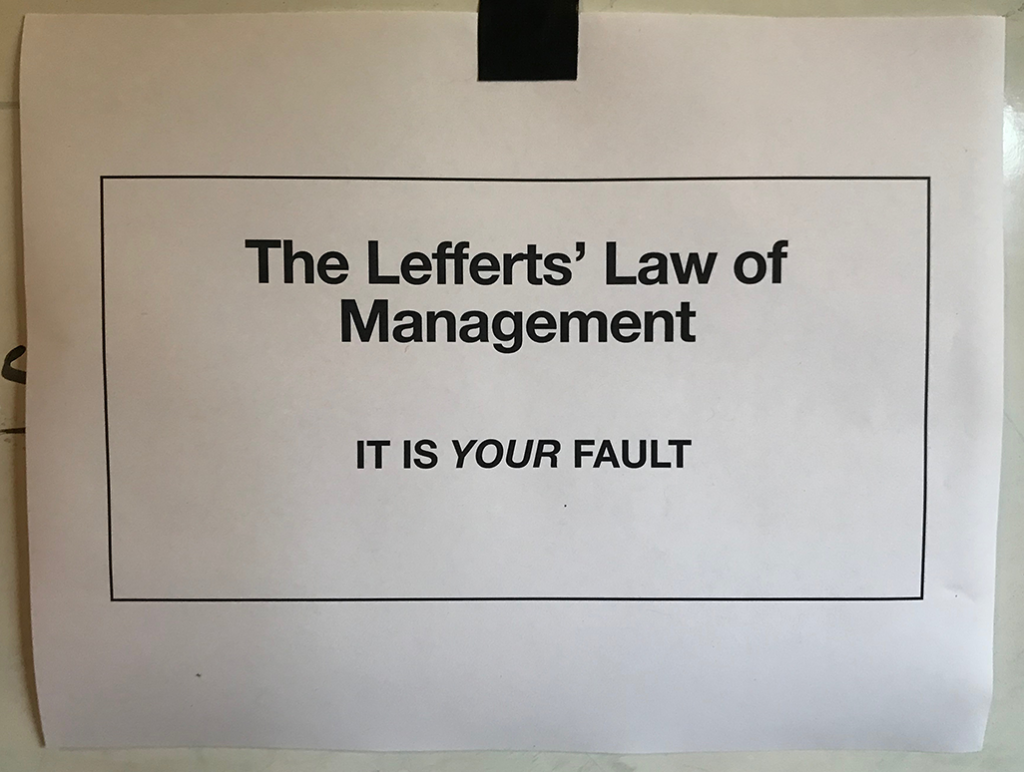
My friend Rob Lefferts, VP at Microsoft, offers this gem of advice:
It is your fault.
I call this the Lefferts’ law of management. The last thing you should ever do is blame your own team. You have more power, and are paid more, than anyone else. If something is wrong, it is probably because of you. There are dozens of excuses you can use instead that point the blame elsewhere but if you want to be a good manager don’t use them.
If someone is behind schedule, communicates poorly, or made a bad decision, who coached them, or failed to? You. If people are arguing and don’t trust each other, who shaped the culture or failed to create shared goals? You. If you feel you must micromanage to keep quality high, that’s on you too for not hiring better or coaching them into growth. Whatever the thing is that isn’t going well, you are the primary person that both caused it and can do something about it. Even if you inherited a problem, it is your job to manage it. If you’re not sure what to do, it’s your job to admit you are over your head and ask for advice or step away from being the boss.
This law should be the primary working assumption in trying to understand a situation. Certainly there will be cases where someone else is at fault, but start your diagnosis by assuming otherwise.
If you are the executive, the boss, the manager or in some cases the leader, you should tend to absorb blame for what’s going on, freeing people to actually solve problems instead of pointing fingers. Be the fall guy if needed for your own boss or partners. If people see you take bullets for them, soon they’ll be taking some for you, or prevent the need for anyone to at all.
Being passionately accountable creates a shield for others and makes it safer for them to invest more personal responsibility in their work. When they do, things can only get better.
When in doubt, good managers assume anything important that’s not going well is their fault and do something about it.
[edited lightly 9-23-2016, 9-24-2020]
Yes, yes, yes!
This works with parenting too.
A very good point, I agree with this but you need to temper it with the gaining of respect otherwise you’ll end up always taking ALL the bullets! Jay has a really good post on this at:
http://www.jaymorrissey.com/2008/03/09/respect-is-kindness-your-weakness/
That’s wise one.
And actually pragmatic programmers have similar advise in their book.
Not always sage advice…
In many situations in large organizations there are groups ‘collaborating’ on a project. These groups are often filled with workers with sloppy shoulders and managers trying to align themselves with the next big win and distance themselves form (often their own) failures.
Absorbing blame in these situations will lead to more valueless work initially and probably getting sacked when things get tight and they fire ‘that useless guy who always messes up other people’s projects’
Sorry, but I just don’t think this is valid advice for everyone.
I would add to Jan’s comments my viewpoint.
I think it’s important to clearly separate what’s your fault, and what’s not ; what is under your responsability, and what is not. Unless that, you’ll be a kind of “shock absorber” for all the organization…
While taking responsibility is important, I think your last comment of “do something about it” is even more important. If somebody takes the blame for things without taking action, they look incompetent. Conversely, somebody who takes action on things that aren’t their fault looks like a proactive leader. So I almost wonder if the advice should be to take action rather than to accept blame.
Jan, couldn’t then “doing something” be getting those people removing from the team or organisation? If they are actually incompetent then that’s a problem that can be fixed with enough effort :)
From NathanielB’s flickr page.
Agree almost 100%. The only drawback to this is that what one perceives as a ‘problem’ may only be a problem to that person alone, which leads to micro-managing. First, you need to ensure there really is a problem to be resolved, not just a difference of opinion on how something should be executed. Then, work with your employees / teammates to find a resolution that doesn’t alienate anyone (or as few as possible).
See, I’m in a position right now where my director (one step down from VP) thinks she can do everyone’s job better than them. What she perceives as problems only exist as such in her own mind. Thus, the “problem” shifts to us, her employees.
I’m a firm believer that in life, if you have an issue with something, you’re the only one who can fix it. But, when it comes to working with others, you need to decide first if the issue is within yourself or shared with others.
Jennifer: I agree. The goal is to do this without micromanaging.
See https://scottberkun.com/blog/2009/letter-to-micromanagers/
No offense to the ladies reading this – I always thought that part of “the mark of being a man” included taking responsibility for your role + actions. since when did that change such that we need a law to remind managers (pre-dominantly male, by the way) that they need to be responsible?
back when i was serving in the military, I had a good “manager” (a senior warrant officer, to be exact). He was harsh, demanding and the nightmare of every enlisted man. I learnt however that he led by example, and never pushed the blame (when things go wrong) even though he could have pushed it on us. Though he was rather stingy with his rewards, his men respected and loved him for his trustable leadership. I see a very sad lack of leadership, esp in the IT/comp science sector – but i think everyone can see that.