
Book review: The checklist manifesto
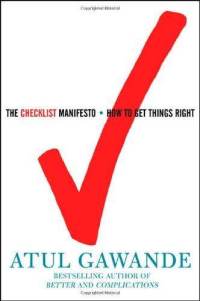 Gawande’s first effort, Complications is a great book. He’s honest about the limitations of surgeons in a way few doctors are: it’s fantastic, doubly so if you deal with doctors on a regular basis. His second book, Better, was ironically not as strong, but a worthy read on how a thoughtful surgeon (Gawande) thinks about proficiency and skill development.
This book, the Checklist Manifesto, is harder to recommend. First, it’s not a manifesto, it’s too thin, long and even-tempered to hit that mark. Second, it falls into the Dan Airley (Predictably Irrational) trap of insisting on telling the author’s personal stories of learning, even when they’re repetitive and predictable: it’s clear through all 100 pages of Atwande’s conversion to the wonders of checklists in the first half of the book that he will, in fact, be converted.
The prize in the crackerjack box that is this book, the part that made the book worthwhile, is Gawande’s interview with Dan Boorman, an expert at Boeing on the checklists pilots use in emergencies. He makes clear why most checklists in our lives earn a bad reputation:
“There are good checklists and bad… bad checklists are vague and imprecise. They are too long; they are hard to use, and they are impractical. They are made by desk jockeys with no awareness of the situations in which they are to be deployed. They treat the people using the tools as dumb and try to spell out every single step. They turn people’s brains off rather than turn them on.”
But Boorman continues and offers a design minded view of what a good checklist is:
“Good checklists, on the other hand, are precise. They are efficient, to the point and easy to use even in the most difficult situations. They do not try to spell out everything – a checklist cannot fly a plane. Instead they provide reminders of only the most critical and important steps – the ones that even the highly skilled professionals could miss. Good checklists are, above all, practical.”
It made me long for a book about Boorman and his experiences in the world trying to teach people who tend to make the former, to make the later. There’s a short interview with Boorman here (PDF).
Gawande is an excellent writer in every sense of the word. I enjoy his pieces in The New Yorker and elsewhere. But this book would have been better suited at actual manifesto length (50-100 pages) or structured less on Gawande and more on his subject. Unlike medicine where his insider observations fascinate, here on more ordinary subjects his personal narrative isn’t sufficient to power an entire book.
As a former combat pilot, check lists serve an important function not mentioned in the book or by Boorman. They are the “binding force” between the Pilot in Command and the Second Officer (Co-Pilot). Watch the pilots in a commercial airliner (if you can sit in the 1st 5 rows and they leave the flight deck door open). They are exchanging words as they go down the check list for push back. These words have been said several times that day of you’re traveling after noon. They know what to do, but the exchange of words confirms to the other person, that they “know what to do.”
If you listen to radio conversations for commercial airlines or military pilots the words are exchanged in double sentences.
Proceed to 270 (heading) is repeated as “proceed to 270, even though the 1st officer heard it the first time. This rhythm is “two phase commit” is built into the check list. It is part of the “I’m telling you I heard what you said.” Followed by “I heard that you heard what I said.”
We work complex defense and space programs on the cost and schedule side. 10’s of 1,000’s of little details, produced on deadline every month for 100’s of millions and some times billions of dollars. The “team” speaks to each other in the same check list manner. Glen to John – “John, the negative slack in Control Account E01, Work Package E01.01.56 has been removed when I deleted the subcontract connection.” John to Glen, “Glen I removed the subcontractor link and the negative slack is gone, I’m moving the IMS (Integrated Master Schedule) back to SAP for baselining.”
This way we speak about outcomes, impacts of those outcomes in black&white terms with no opportunity for confusion.
Nouns and Verbs only. No adjectives or adverbs.
Find a Frontline episode on Iraq or Afghanistan to hear the soldiers talk to each other over the radio or within their vehical to hear what “check lists” sound like. During high stress the check list language leaves NO room for confusion.
This is the current example
Check-lists are at the heart of a quality system. Non-experienced people could benefit from a check-list maintained by experts of the field. Check-lists help to not reinvent the wheel.
For the french speaker, I’ve wrote an article 2 years ago on the subject of checklists :
http://jradix.blogspot.com/2008/06/larme-absolue-de-la-qualit-la-checklist.html
I too read the book. I wouldn’t reject it as hard as you did, infact I liked it. However I do agree that it’s not a manifesto and that the Boorman part was the best part of the book.
I also liked the part where Boorman discusses testing the checklist. Which is extremely interesting. How many Software Companies test their documentation as thourogly as the flight checklists are tested?
Morten: I’m glad you mentioned software development as many companies I know of have bad checklists. They try to cover everything in terms of checkin procedures or UI guidelines, and bury people in them, and often it has the opposite of the desired effect.
Many people who work in quality control or who create guidelines could learn from this book, and specifically from Boorman’s advice.
I LOVE checklists. I will take a checklist over a procedure anytime.
My love for checklists is the reason I wanted to read this book. I still do. Thanks for the review all the same.
The issue with checklists is the same as with warnings. Bury the crucial in a sea of irrelevancy, and people tune out everything. At some point, the warning/checklist ends up having the opposite of the desired effect: instead of actually heightening attention, it lessens attention because the user has learned that there are zero consequences for remaining inattentive.
My favorite example is the warning plastered all over everyfuckingthing in California that contains any sort of chemical: “This whatever has been determined by the State of California to cause cancer.” You’re standing there in the supermarket and this stupid sign is hanging next to the toothbrushes. You learn that this warning is 100% meaningless, and it teaches you to ignore all warnings.
An important good reason for checklists is also that they formalize communication so that social/cultural constraints do not impair the transfer of life-or-death information. By working via checklists as described in Glen Alleman’s comment, you can help prevent disastrous outcomes like a Korean airline second officer using only very gentle, respectful language about the altitude of the plane as the captain flew it into the side of a mountain.
Elisabeth: you’ll dig the book – but as I mention, the first 100 to 120 pages is largely Gawade’s story of conversion to belief in the power of checklists, and it’s about 80 pages too long.
There is still definitely a place for someone to write a true manifesto on checklists – maybe it’s you?
Excellent summary. Agree. Essence of the book is in one chapter. Stories are interesting but not essential to understanding how to develop effective checklists. Boorman experience provides the link to a more in-depth understanding.
I recently read the book “Business Brilliant” by Lewis Schiff. He was discussing a great achievement by Allegheny General Hospital where they instituted a simple checklist procedure to virtually eliminate patient deaths from infections. His observation was that you typically have to cajole and badger doctors into following any type of procedure. The following quote sums up the essential difference between a checklist for a doctor and a checklist for a pilot.
“How can I put this delicately? Pilots are seated in the same planes as their passengers. Surgeons are not under the same knives as their patients. To paraphrase an old joke, surgeons may be interested in safety, but pilots are committed.”