
Confessions of a self published author
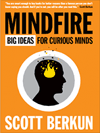 Lisa James McKenzie, one of my kickstarter supporters, requested a behind the scenes summation of my experience self-publishing my new book, Mindfire: Big Ideas for Curious Minds, a book of advice on thinking, wisdom and living a creative life.
Here are all the questions I’ve been asked, with honest answers:
- Why did you do this? You’ve had 3 bestselling books the traditional way. I know I will be writing books the rest of my life. The sooner I learn everything about the process, the better off I will be. I already know how to write – it was time to learn how to publish. Learning was my primary motivation. Even if this book doesn’t sell a copy, but I learn things that help my future writing career, it was worth it (Longer answer here). I’m friends with everyone I’ve worked with at O’Reilly Media. There are no hard feelings there.
- What was awesome about the process? Control. The cover, title and content for any published book involves rounds of discussions between the author and the publisher, assuming you can find a publisher that is interested in the book at all. If you self-publish, you, the author, are in control. I got exactly as much input from others as I found useful. I used my blog to get feedback from my readers on the title, on the cover, and the book itself, but I had complete control over that process.
- What sucked about the process? Control :) If you have control over everything, you have to take care of everything. Every single task must be done by you, or you must hire someone to do it.
- What was unexpected? It was easy. If you can make a PDF, and hire a good designer, you can print a professional looking book. The hard part, as always, is writing the book itself. If you can write a book, you can self-publish a book. Anyone complaining about finding a publisher, but has yet to write a paragraph, is fooling themselves. You can be your own publisher at any time, provided you actually write something.
- How did you hire people? I used scottberkun.com to find a designer and an editor/curator, by asking people to apply. I wanted to find someone already interested in my work, or through my network of readers. The response was amazing (~40 people applied for each role). I picked 3 people for each role and paid them to do a trial task. Based on the results, I hired Tim Kordik (cover and interior design) and Krista Stevens (editor). The always amazing Marlowe Shaeffer took over the editorial reigns for the last leg of the project and helped drive it home.
- What were the costs? If you use a Print On Demand printer, costs are low. You’ll need to hire a designer and editor, but otherwise the base costs are a few hundred dollars. You pay a fee to setup an account with the printer, the e-book service and for an ISBN number. You also need to have an LLC to work with some printers. PR and marketing are likely the largest costs you will have, but how much you spend is up to you.
- What services did you use? Based on research, and advice from author Phil Simon, I used Lightningsource, a Print on Demand service (POD). POD means there is no inventory – they print books as they are ordered (which happens so fast, no customer on amazon.com would ever know). I also considered CreateSpace, which is comprehensive and more consumer friendly. They also take care of listing the book on Amazon.com (Update: I used CreateSpace for The Ghost of My Father and highly recommend the service). I used bookbaby.com for all the e-books: they take an epub file, and convert and deliver the book to kindle, iBookstore, B&N and Sony Reader.
- What was a pain in the neck? Some of these services are not designed for consumers, so their websites suck and take time to learn. The worst offenders are Lightningsource and Bowker.com (the service used to buy ISBN numbers). Once learned, most processes are easy. The other major issue is timing – these services do not guarantee specific dates, so launching a book is hard to time PR-wise. The other challenge with POD is there are no pre-orders. I used kickstarter to help solve that problem.
- What about marketing? Publishers rarely do very much to market most of their books, unless you are already famous enough to justify a good return on that investment. It’s true self publishing means you are entirely on your own, but the gap for most authors is far smaller that you’d think. Even when a publisher does a great job, most marketing for books involves the author: interviews, appearances and blog posts. It still depends on the author doing work. The question is: does the publisher’s value to the author justify the share of profits they will take?
- What would you do differently? Not much. I’m not sure the next book will be self-published, but I’d definitely consider doing it again.
- Would you recommend other writers self-publish? Here’s advice for advice for first time authors. Provided the person is actually writing, and not merely talking about writing, a smart publisher, and a good editor, can make for great partners with a writer. It depends on how much of a partnership a writer needs or wants. Some writers need the structure and support publishers provide to get started, to guide the book with tough feedback, or to finish. And many publishers have greater knowledge of PR and marketing than the writer does. My recommendations depend on who the writer, publisher, and editor are. First time authors are likely best served by working with a publisher, as they have much to learn about every part of the process. But learning on your own is better than waiting around for a dream to come to you.
Want to see the results? The free preview is here – Mindfire Preview (PDF) – its nearly 1/3rd of the book, all for free. Take a look – let me know what you think. So far the book is doing well with nearly 30 reviews.
If you found this post useful, buy the book, ya?
What questions do you have? Leave them in the comments. I’m happy to answer.
Hi Scott!
Has it been more lucrative self-publishing? One imagines that the value-add of editors is working with a publisher, and getting access to all of their distribution network and advertising resources. I’d be interested to hear whether, with your network and reputation, you’ve done better going it alone.
Dave.
It’s too early to say – the book just came out. I do know that my per book sale income is much higher, so I don’t need to sell as many to make the same amount in royalties.
The value-add can be true, but the rewards per book are lower. There’s basic math a writer could do about the comparative predicted sales numbers, and the per book profit they’d likely make.
Most publishers augment their own PR by hiring PR firms to assist, which self-published author could choose to do as well.
I am realy lifted,i feel my dream author emerging and atleast i know i have not been dumping my hours on paper.please if you would need to help more.you can check for me on facebook(misheck mwanza.”malcolm teacher”)
i appreciate God bless you.
If i would like to use creatures to write my next book such as goblins or elves such as J.K> Rowling did in harry potter or J.R.R Tolikin did in the lord of the rings but in my own book, would that be a form of plagiarism? Also i just got completed in writing my 1st book called Epilepsy an d the Epileptic. i am just waiting on my editor now as i speak.
This was extremely helpful! Thank you so much! Also, I am thinking about self-publishing my book. I am only 14, so this will be a challenge. But I don’t need an illustrator because I am an artist, a good one I think, and I will illustrate my own book, but I’d like to know more about self-publishing.
I’ve never written anything, but I’ve read a great deal. It’s from a reader’s perspective that I write this post to you: GET AN EDITOR.
When you read books like DW Jackson’s “Inexperienced Mage”, where the grammar and punctuation is horrendous, it makes it truly difficult to get through. Don’t get me wrong, the story was good. But don’t mix up your homonyms (a horses gate? I think he meant gait), PLEASE use commas, and CHECK YOUR SPELLING.
I often wonder how some of these books get published at all.
Hi Scott, can you please explain why the Kindle edition is more expensive than the print edition? Is it Amazon’s policy?
In the U.S. The kindle edition is cheaper. I don’t know why amazon prices kindle books differently in other regions. I can try to find out, but to answer at least part of your question, it’s not a deliberate choice of mine.
The price that amazon asks right now on amazon.com is $8.98 (discounted from the list price of $14.95) for the paper edition vs. $11.72 for the Kindle edition… BTW I already own the book, I bought it on kickstarter and I ENJOYED EVERY LITTLE BIT OF IT. I am not complaining, I am just curious.
I just realized I have bought 3 of your books, and I want this one too. Will buy it soon (dealing with Christmas for the 6 yo now, Nintendo 3ds and games–yikes).
Thanks for the call-out, Scott. The book looks great and I love how you crowdsourced.
I’m looking forward to digging into the book!
Question: would you ever consider going digital only, and ditching the print versions?
Hi Scott,
This is a great write up on self-publishing! I have also self-published and am in the process of writing some blogs on it, in particular the sales side of publishing. There is so much for people to consider!
As I’m sure you have discovered, when you self-publish you essentially create your own mini publishing house. It’s a full time job! But it can also be very rewarding.
Have a great Christmas and New Year.
Best wishes
Priya
Great read, I enjoyed it just like the others!
Hi Scott,
I discovered your blog today while searching for info on the process of designing a book cover. I’m a new author who is struggling with the question of whether to self-publish or traditionally publish, and I enjoyed reading your insight into both worlds.
I’m determined to get my work out there, but I worry about the gatekeepers not letting me in (traditional publishing model).
Thanks for the great articles. You’ve got a new reader here!
Nat
Hello Scott! I just started writing a Fictional book of my own. Any tips? I wouldn’t want to publish just yet. Once I had the idea, I started typing. It become so many things in so many ideas so fast, that I need the help I can get.
I decided to self-publish and I’ll leave this page even more convinced by your answer to the first question “I know I will be writing books the rest of my life. The sooner I learn everything about the process, the better off I will be.” I saw you speak at NYCWP today (promoting #nopants) and I realize this post is almost two years old, but it’s still doing some good in the world!
Now I’m scared, I wanted to self publish but I don’t know now.
I have always felt that “setup” was a noun and “set up” was a verb phrase. So I would have used “set up” in “You pay a fee to setup an account with the printer”.
P.S. I have a web site whose URL is “www.TenderMercies.Us” but your form rejects it, saying, “Please enter a URL.” I think your “smart” form outsmarted itself.
You wrote, “The question is: is the publisher the value to the author to justify the share of the profits they will take?”
This is hard for me to understand. How about, “The question is: is the publisher valuable enough to the author to justify the share of the profits they will take?”
Thanks David. Fixed.
Good correction but bad examination
Hello Scott. I’m 75% finished with my book. What are good signs in finding a good publisher? What is expensive? What is reasonable? I thank you for posting this site. This will be me first book and I need all the help I can get. Also do you recommend a local publisher? Someone you can sit in front of?
Hi, one thing I am wondering about is having a self-published book is having people (well known educators/authors) read the manuscript before it goes out to the public in order to put their comments in the book. How do you go about doing this? Is this more the marketing aspect? Thanks for all of your helpful information : )
Not sure I understand. If you want contributions from other people, why wouldn’t you just contact them with a draft of your manuscript and ask?
Hello Scott. I too am a new writer. I have some questions, and I hope you are able to advise me on anything that you can think of. I am a senior citizen with a huge background in Escorting. I have lots to write about, but not sure if there are limitations or boundaries as to how much I will be able to say, and how to keep it from being too X rated, and how to go about publishing this sort of book. Also, I don’t want to get into trouble by admitting to doing something that is illegal. I’m thinking about calling it fiction, and changing the names too of course. I am just now working on an outline to my very unusual story, and thinking that it may be best to get an editor. I am wondering how much they cost or how do they charge. Any advise you may give me will be much appreciated. Thanks. Gail
Hi Gail:
Start by doing some research – there are many books already published about escorting. By studying them you can see how they solved (or didn’t) the challenges you list.
If you’re looking for an editor or advice on publishing, I’d recommend starting here at Jane Friedman’s site.
I have been reading your book for five minutes and absolutely LOVE it. I will definitely share it! Thank you.