
Why Great Ideas Fail
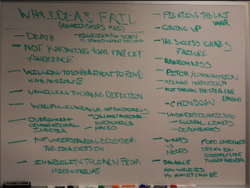 I ran a session at FOO camp on Why Great Ideas Fail. The goal was to leave the room with a list of reasons and here it is.
The crowd was tech/start-up folks and the list is shifted towards those pursuits. Fascinating how many of these are opposite pairs of each other (e.g. gave up too soon vs.stayed with same idea for too long).
Why Great Ideas Fail:
- Killed idea too soon
- Launched idea too early or too late
- Death (of person with the idea)
- Someone got their first and stayed in front
- Not willing to experiment to find audience
- Unwilling to change direction
- Willful ignorance of economics
- Not knowing target audience
- Unable to overcoming organizational inertia
- Not understanding the ecosystem the idea lives in
- Inability to learn from microfailure
- Fighting the last war
- Stayed with idea for too long
- Giving up
- Chindogu – solution causes more problems than it solves
- Factors beyond anyone’s control (market, wars, competitors, natural disasters, etc.)
- Failed to pitch or communicate well
- Underestimated marketing
- Not taking the idea far enough
- Taking the idea too far too early
- Underestimating cultural limits
- Underestimating dependencies
- Failure to balance how world is vs. how world can be
- Failure to balance wants vs needs
Thanks to Val Aurora, I also got a list from attendees of personal reasons great ideas failed. Wide range of levels of specificity, but still interesting,
Specific failures people listed as their own:
- Forcing something on people they don’t want
- Not controlling distribution (e.g. Tivo vs. Comcast DVR)
- Not doing post-mortems
- Not eating our own dogfood
- Building something ‘powerful’ but too complicate for the average user
- Force change earlier. It won’t happen on its own.
- Launching a product before it’s ready – unreliable performance
- Not killing a project/startup faster (i.e. spinning wheels for an extra year instead of getting it out the door)
- Trusting before researching
- Not trusting my gut
- Not considering political capital within a large organization
- Trusting my gut too much
- Juggling between being your greatest supporter and your greatest critic
- Voice version of twitter circa 2005
- Built an Airbnb before Airbnb, but didn’t see it through
Thanks to @jessykate for the photo of the whiteboard, from which these notes were transcribed.
Two comments…
1) What gives an idea the label of “great”?
2) If it failed, wasn’t it likely that it wasn’t a great idea to begin with? In other words, shouldn’t we reserve the “great idea” for the “great idea + great plan + great execution” bucket? I’m not sure I want to separate the idea from the execution because ideas evolve with the execution itself.
Great stuff anyway.
“There are trivial truths and great truths. The opposite of a trivial truth is plainly false. The opposite of a great truth is also true.” — Niels Bohr
Great list. I tried to group these (35 by my count) up by concepts (subjective tagging) and got these:
Attitude: 8
Audience: 1
C’est La Vie: 1 (the Randomness one)
Execution: 9
Learning: 2
Organization & Culture: 5
Person Dependence: 1
Quality of Idea: 4
Timing: 4
yeah, same to me :(
Interesting difference I observe between the generalized group one and specific/personal group two …
Group one can include one’s own blindness/failings as the reason – eg. didn’t pitch well enough
Group two typically blames everyone but the self eg. not controlling distribution.
This isn’t 100% accurate, but it is very human. When we can talk in generalities it seems easier to allow ourselves to be at fault. If we are asked why our specific and personal project failed, it is very hard to own up to our role in the failure.
Interesting project. I look forward to hearing more.
yes please @ Follow up: If you were there, or not, and want to be updated if this project gets off the ground, leave a comment.
I agree with @Christy that the personal reasons for failure are all too human, i.e., subjective and rarely blames oneself. A lot of ideas here needing more details. In a book, perhaps, Scott?
I second Marcelo (and I think we’ve had this discussion before)… how can we say it was a “great” idea if it failed?
I can see the label “great” for ideas that someone else later DID go on to find success with, but I, too, believe that it’s not always useful to decouple idea from execution.
I guess I would not define an idea as “great” if it wasn’t coupled to how people will be willing and able to use it. I CAN see lots of space for great-except-for-X, where X could be, say, “too soon” or “based on Y, and Y imploded”, etc.
Nice list. Still wish I’d gone to that session.
I am not sure geography was covered here. A great idea followed by all the elements that help convert the idea to a successful launch may not work in a different country.
Reasons are many including but not limited to the political climate, powerful business that don’t tolerate intrusion in their space, ambiguous regulations that always tend to favor the rich, etc
I’d add…Not engaging with your audience and adjusting your idea with that insight.
Great suggestions.
Thought of a good one tonight: There was an even better idea you were competing against.
Here’s one to add:
Objective reality doesn’t give a fuck about you and your goals.
Great list. Interested in follow up and also support Marcelo-s comment.
If it was such a great idea, why didn-t it take off despite all the caveats that you have listed? Isnt reality/implementation the ultimate check regarding whether it truly was a great idea?
@gastonbilder
You might consider separating ‘ideas’ from ‘businesses’. There are plenty of great ideas – but they might not be viable, sustainable revenue producing businesses. Maybe the question should be, “What stops an idea from becoming a business?” Sounds like a great event – keep me posted if this goes anywhere.
Some great ideas fail because there is nothing great in them. One of the worst things we can do is just copy cat other people’s ideas, especially if we don’t give others credit for them.