
How to Get The Most Out of Conferences
Conferences are what you make of them. If you’re not sure why you’re going, or what you want to get out of the experience, you’re unlikely to get it. I’ve attended over 100 conferences, and have organized some too, and this is the best advice I know.
Conversations are more valuable than sessions

The big revelation is that the most interesting moments will likely not be in the sessions themselves. Instead, it’s the conversations you have with interesting people, people who give you new insights, new stories, make your laugh, validate your experience, or challenge you with new ways of thinking. This is a surprise, since the marketing for events focuses on the sessions and the speakers. Sessions can be wonderful, but at best they are one-directional experiences where you are a recipient more than a participant. You can often watch videos of talks or view the slides when you return home. What you can’t do later is talk directly with interesting people who share your interests, who can teach you things, share insider stories and possibly form new friendships.
This means that you need to prioritize spending time socializing with other people. If the conference is well designed, there should be many opportunities to meet people, through small group sessions or social activities. But if there aren’t there are always things you can do to make them happen on your own.
How to Prioritize your time
Our brains learn best if there’s some kind of interactivity. Think about it: wouldn’t the ideal be to have each expert speaker give you a personal and customized one hour lesson on their topic for your price of admission? But that’s not how the economics of events works. To make it fly logistically experts are usually asked to give presentations to hundreds of people at the same time and the way they teach is limited because of that format.
When I look at the advanced program for a conference, here’s how I rank the different kinds of sessions:
- Contribute: Most good events have ways to participate and you should. Often anyone can submit a presentation, a panel session idea, or a workshop proposal. Some events have lightening talks, where anyone can talk for 5 minutes. The reason contributing matters is it makes you an insider: you’ll meet other contributors and get to know the organizers. Even if your submission is rejected you still get rewards: you’ll force yourself to think about what’s important to you, or what topics you most want to talk to others about. Some events have volunteers who help run the event and often they’re younger and more social: by joining their ranks you’ll have a built-in network of people to talk with between sessions.
- Workshops/Tutorials: Many events have slots for one leader and a small group to work together. These are often the most enlightening sessions, as they are smaller, more interactive and can go much deeper than a lecture can (assuming the workshop is designed well). Even in a bad workshop, since you’ve shared a half day together with other participants, it’s easier to find people to socialize with over coffee, under the guise of “want to get some coffee to talk about what we learned (or didn’t)?” Sometimes these conversations are more valuable than the workshop itself.
- Informal Gatherings: Some events have signup sheets for reserved spaces where anyone can lead a conversation, and anyone can sit in. Often these are disapointing, as a good conversation requires someone to lead it well. See my advice on running unconference sessions for how to facilitate informal groups. These are sometimes called SIGs (Special Interest Groups), or BOFs (Bird of a Feather).
- Presentations. The majority of sessions at most events involve one person on stage lecturing a large audience. This can be a good way to learn if the topic is right and the speaker is good, but good speakers are rare. More importantly, you are a passive observer in a lecture even if it’s a great one. By taking good and simple notes, you become a more active listener: you’re guaranteed to learn more and have a good reason to start a conversation with speakers during or after the event.
- Panels: A panel session has 4 or 5 invited speakers sharing a time slot together. In better panel sessions, there is a diversity of points of view, and everyone is comfortable sharing them. But too often, panels are terrible. The panelists shy away from the intended topic, or avoid disagreeing with their co-panelists. For these and other reasons, panels are a wild card, and often result in forgettable experiences.
 Posters: Some conferences have poster areas, where professionals or students put together summaries of their work. This can be fun, as it’s a passive way to skim what people are up to, and can be more stimulating towards asking questions than reading online. Some events will have a set time when the authors are around, leading to conversations about what they’re working on.
- Paper sessions: At more academic conferences, there are paper sessions, where the authors of selected paper submissions get a chance to talk for 15 minutes about their paper. This is a terrible waste of time for conference attendees. First, the papers are available online. Second, these folks were accepted on their ability to write a good paper, not on their ability to engage or communicate through a presentation.
How to build your plan
Before the event take the schedule and mark anything that’s interesting. Circle those sessions and if two or more occur at the same time, flag the one you want to go to first.
Then during the event, you already have an outline for what to prioritize. Have a plan to bail after 15 minutes if you’re bored (Siting near an aisle or towards the back makes this easier). Odds are it’s not going to get better. Simply go to the next session in that time slot that interested you. Repeat the same thought process. The result is that you maximize your time spent in sessions you will actually enjoy, and minimize your time spent bored, hoping things will get better.
If you run out of interesting sessions to go to, head for the trade show or main hallway. An easy way to meet people is to simply chat with the folks in the booths or others who seem bored by whatever sessions are currently happening. I’ve had some of my best conference experiences in conversations that started this way.
Be social, even if you are an introvert
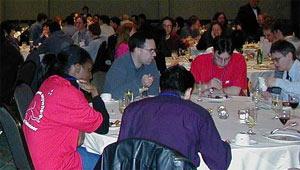 Most conferences have scheduled social events, but often it’s so loud or large that it’s hard to meet new people. Often, by the night of the event many people have already formed cliques. If you’re alone, these events can be intimidating.
The helpful reminder is that everyone is at the event to learn and most are there to talk to interesting people. An easy way to start a conversation with anyone at the event are questions like:
- What was your favorite session so far? Or what did you think of the keynote?
- Is this your first time at this event? How did you pick it?
- What’s an interesting idea or technique you’ve learned about here?
Although it’s harder for introverts, having a couple of icebreakers and a smile goes a very long way. Remember you are in a special self-selecting group at any conference. These are the minority of people on planet earth that do the same kind of work that you do and have chosen to go to an event. It’s a far narrower social group that you usually experience – you know these people since you are one of them. The stakes for starting conversations are much lower.
If you can manage it, you want to try to have met enough people in the workshops and other sessions in the previous day, that you can wander around at the social, and say Hi to people you’ve already met. You’ll be able to politely join conversations and meet more people. If you have a drink or get the right mindset through non-chemical means, it can be great fun bouncing around between different groups.
If your goal is to grow your network or make new friends, have business cards. It’s still the most socially acceptable and least awkward way to exchange contact information.
Make your own meetup
Everyone wants to socialize, but few are willing to take the lead. It’s not hard. Nearly everyone needs to eat and wants to make new friends over drinks, they just need an invite or a nudge. When the last session of the day begins, everyone is thinking about what they’re going to do later.
Try to set yourself up with a plan early in the day: ask people you meet in sessions what their plans are. Often they’ll say that don’t have any, which is your ticket to make some.
Pro tip: tell everyone you connect with during the day to simply meet at 6pm at the main hotel lobby (or preferably the lobby bar). It’s an easy plan, easy to remember and low commitment. Then once you have a group, decide on a nearby restaurant and go (this is often better than staying in the noisy, distracting, generic hotel bar). People will appreciate you taking the lead, and this approach really doesn’t require much effort. Worst case you are in the bar alone, but odds are high other attendees from the event will be there, and if you introduce yourself, you can likely join up with them.
Take advantage of being away from home
Conferences give you a chance to see a different part of the world. Don’t waste it. If your organization paid for your travel, take advantage of their investment. See if you can stay an extra night at their expense, or use vacation days. Wise managers know the entire idea of sending you is to give you new perspectives and ideas, and some of that can best happen outside of the event itself.
- Avoid chain restaurants and stores. You can go to these places at home. If you have to pay out of your own pocket for better/more interesting food or experiences, it’s worth it. Also stay away from hotel restaurants. They tend to provide decent but safe and tame food choices.
- Stay at the conference hotel if you’re new, but otherwise.. If you want to maximize your chances to meet and socialize, staying at the conference hotel has advantages. But otherwise, stay in a more interesting neighborhood. Having a walk each morning through an actual neighborhood (rather than the sterile places conferences centers often are) gives a different perspective, far more interesting than merely taking an elevator ride to the conference level of the same hotel.
- Take a road trip. Early in the conference ask around for people who might want to take a short road trip one night, or skip out on one afternoon’s sessions. If you end up going with other conference attendees, you have no reason to feel guilty about this. Your odds of learning something, and making connections are greater if you do something together outside of the conference, than if you do something inside.
The benefits and drawbacks of going with friends
It’s common to attend a conference with coworkers. This can be great. You’re likely to bond more, and spend time together in a way that doesn’t happen at work. I’ve made lots of friends from work by meeting them for the first time at conferences. It’s natural that if you work the trade show booth with someone, you’re likely to learn a lot about them, and have a chance to meet people who may share your sense of humor.
However, if you have 2 or 3 friends that you’re traveling with, you might find it easy to fall into a pattern where you spend most of your time with them. If it’s assumed you’ll all eat dinner together every night, you’re not going to meet new people. One trick is to go to dinner together with coworkers, but require that everyone bring someone they met at the conference. Or agree that at least one night, everyone had to go out on their own.
Relax and have a good time
 Many folks take conferences too seriously. They worry too much about being efficient with their time. This works against the larger goal of growing and learning.
And as much as we like to think we’re critical to our teams and companies, they can live without us for a few days. Plan your time before your trip so that while you’re away, you can stay away. Tell your coworkers you’ll online be online at set times during the day (office hours), or that you’ll only be checking email in the evenings.
If you have people that work for you, set them up to cover for expected situations that might arise. Give them your hotel phone number or cell, and let them call you if they need you. Otherwise, you don’t need to check in or check your email every day. Really, you don’t. You think you do, but you don’t. It can be a way you’re hiding from the social anxiety of trying to meet new people.
How to justify going to conferences
There are classic ways to argue that it’s in your employers’ interest to pay for you to go to a conference. It’s a good sign of their long-term interest in you that they invest in your skill and career development (which is why at most elite corporations, it’s standard for knowledge workers to have a per employee training budget that’s often enough to pay for one conference a year).
- You are an asset to your company. All assets require maintenance and enhancements. If instead of being a person, you were a piece of machinery, part of the corporate budget would go towards maintaining and upgrading you. Well, despite being human, you are an asset to the company. They should be investing the same percentage of budget towards maintaining and upgrading your skills as they do for the rest of the corporate assets.
- Offer to train others in what you learned when you return. You can pitch your trip to a conference as a way to bring back skills and knowledge to the rest of the organization. If you have any experience in training or teaching, you can use that as your justification to attend instead of other co-workers. Get extra copies of the tutorial notes from other sessions. This is often a cheap way to get some extra coverage.
- Trip report. Arguably one form of teaching others, the trip report is a write up of the sessions you attended, written for other folks in your group. The best trip reports make it easy for folks to dig up the right reference, or trigger people to come ask you questions. There’s rarely much value in 10-page trip report documents: no one reads them. Instead, a 2 or 3 page summary, with URLs and pointers gets much more mileage.
- Connect the value of the conference to business goals. If ease of use or customer satisfaction are company or division goals, you can claim that sending folks to conferences on those subjects will help pull in more expertise and knowledge towards helping the business. This argument puts less of the focus on your professional goals, and more on the company.
- Recruiting. One of the reasons to send people to conferences is to recruit for open positions. If your team has had trouble filling certain jobs, or know that new openings are coming for your group, you can offer to do recruiting work while you’re there. Most conferences have job posting boards, or allow you to rent a booth for your company at the trade show.
- Professional development. If you have career discussions with your manager, tie your career goals and future development to specific kinds of training or growth opportunities that you need. This might force you to rethink which conferences you’re going to (the cool conference might not be the one that’s likely to help your career/skill growth the most). In some organizations, folks will get to go to conferences provided they are presenting or participating in a session. If you don’t know what your group’s policy is, ask.
- Split the costs. If you believe the conference is needed for your professional development, then you should want to attend regardless of who pays. Offer to split the costs. Or ask just for the time off without having to use up vacation time, and you pay your own way. This can be a way to prove the value of the conference, if you return with great stuff and teach others on your team. But it can also set a precedent for you paying your own way. You might position it as a trial: if you can show that it’s valuable, your manager will pay next time.
Random tips that didn’t fit anywhere else
Some of these might be general travel tips, but they’re related – here goes:
- Don’t use the conference bag, or lug around all the crap they give you. First, it makes you a mark as a tourist to carry the conference bag around outside the conference. Second, traveling in packs of people all using the same bag, all wearing name tags, makes you look like a cult member. You rarely need to lug around all of the stuff they give you. Instead bring a light bag, with enough room for the small conference handbook/schedule, some paper, a pen, maybe something to eat, and some business cards. Travel light. You’ll feel much better if you haven’t been carrying 15 lbs of stuff all day. Don’t bring your laptop if you can’t resist doing work – go talk to someone instead.
- Don’t wear your badge outside the conference. There is nothing sillier than a grown adult with a name tag (Unless it says Rupert or Cornelius on it). When you go back to your room, or leave the conference hotel, you are no longer at the conference. Take the badge and put it in your pocket, or with your wallet/purse so you don’t lose it.
- Ship any books, proceedings or heavy shwag back to your office. If there are proceedings and other materials, such as books you’ve purchased, arrange to have them sent back to your office. Find a nearby shipping store, and drop off your stuff the day before you leave. This saves you the burden of packing 10 lbs of stuff into your luggage or carry-on. Sometimes the conference center has a little office that will do this for you. It’s usually not too expensive and you may be able to expense it.
- Ask lots of questions. Learning is a contact sport. If you don’t make your experiences engaging for yourself, you are guaranteed to be bored. Talk to speakers, paper authors, booth people, the folks sitting next to you, whoever. Ask for recommendations for books, websites or other conferences. If you don’t become an active participant in your own learning, don’t be surprised if not much of what you experience is relevant to you.
- Some conferences serve breakfast, some don’t. Know this before you end up 15 minutes into the first session, sitting in the middle of the room (making it hard to get up and leave), and realize you’re starving. Same for lunch or snacks. Sessions tend to start early, so you probably won’t have time to grab something before the conference if you don’t plan for it.
- Get some exercise every day. I’ve said this before, but it’s worth saying again. Conferences are physically stressful, yet your body gets very little activity. You can reduce stress and improve your brain function by letting your body do it’s thing. Most hotels, especially the fancy corporate conference center types, have nice weight rooms or pools. Take the time to get some exercise at least every other day. Skip a morning session or skip out early if you have to, to find time for this. If you hate exercise, and are in a city, go for a long walk instead of taking a cab. Personally, if I don’t exercise every day I’m really not a nice person to be around, and I struggle with sitting and listening for hours on end.
- Take smart notes. Think about what the notes are good for – you’re writing for the future version of you. What level of detail do you need?
- Planning good conferences and training events is its own challenge – so before you complain too much, realize how much work event organizers are doing that you don’t even notice.
————————————-
Published March 2003 (edited Aug, 2016, Sept. 2018)
Thanks, Scott! This is *exactly* what I was looking for. I’m planning to attend a small group industry conference in a month and am determined to lay out a game plan to make the most of the investment. Since I won’t know ANYONE there, it’s important to have a game plan to meet people and gather as much feedback as possible within the scope of the conference. One thing I’m definitely going to do is blog about it (and leave comments on the blogs of others with an interest in my area), so that I can refine my own thinking. The best outcome would be if someone read my stuff and, because they already know where I’m coming from, approach ME! :o))
Did you stop going to conferences for the last 7 years?
Hi Rob: No, just haven’t bothered to come back here to update the list :) It’s much longer now, for better or worse.
Excellent recommendations – especially the one about wearing the badge outside the conference. The last thing I want to do in a “foreign” city is to look like a tourist. I suspect wearing conference swag away from the hotel is a good way to become a target of crime on top of looking silly.
The co-worker issue is interesting. Ideally I think it’s good to mix mingle time with co-worker time, but I really appreciate the co-worker bonding time, especially if it’s someone you don’t work with everyday back at home.
One thing you didn’t mention was co-worker presentations. Do you want to support your co-workers or do you want to learn something new from outside the organization? A guideline I have is if I can attend all sessions from my organization the entire day, then I tend to favor learning from outside the organization.
One tip I might add is to attend some of the planned lunches/sit-down dinners. I find that when everyone is at a table, the conversation tends to be more inclusive (at least some of the time). Or if not, you can at least listen in without appearing rude (unlike a cocktail party). Lunch can also be a good time to “mingle” away from co-workers, because you can regroup for dinner or drinks later.
Liked this article too. Good advice. Following the event on Twitter is all the rage now too. For example #united2010 (A fresh produce convention in LV) is running as I write this. Great way to meet folks, find good swag, learn about interesting happenings, even food places.
Great advise. Thanks for sharing
This is very good and practical information, thankyou
The tips are pretty useful as I go to lots of conferences around the world. To be honest, going to a conference with coworkers can be really awkward, especially if you feel tired at the end of the day, and you want to escape the evening dinner.
This is all spot-on advice. I attend my share of conferences (LISA, Gartner, etc) and he’s hit one of the big ones:
Avoid (only) hanging out with your coworkers. Meet other people, and learn from their experiences. Take something NEW back to your company that you’ve learned from someone you’ve never met before.
Scott has also “solved” the “4 hours to decide on dinner” problem. *You* pick a restaurant, and all day invite people you meet to be in the lobby at a certain time. Leave on time with whoever is there. 90% of the time people don’t really care *where* they eat as long as it is quiet enough for conversation and has acceptable food. Don’t try to over-optimize to find the absolute best dinner solution. Go for “good enough” and on time.
Hi Scott,
Just posted a link piece to your essay here. Hope you enjoy… I’ve summarised and adapted it for our particular purposes. http://campfirefff.tumblr.com/post/17671438777/how-to-get-the-most-out-of-conferences
Cheers,
Richard
oh, and did i say… thanks for all the great thoughts & tips!
R
Hi Scott! This is exactly what I needed to know going into my first symposium. Good and practical!
Excellent blog! Do you have any hints for aspiring writers?
I’m planning to start my own site soon but I’m a little lost on everything.
Would you suggest starting with a free platform like WordPress or go for a paid option?
There are so many options out there that I’m totally overwhelmed ..
Any ideas? Thanks!
It is your point of reference in how we conduct our actions often changes our viewpoint. Sometimes this alteration is good and sometimes this alteration is bad but it is our point of view that influences the way we feel.
This article has brought out so much of valuable information. I am glad that I found this.Thanks for the share.
Great article and a lot of useful tips for people that haven’t been to conferences before. I liked the section about how to spend your time and recently was reading http://www.bluecotton.com/blog/articles/event-planning/10-things-never-conference-according-experts/, where Allie Siarto said “Don’t go to networking events with friends. Too often, people are intimidated by networking events, so they ask friends to come along. Then they spend the whole event talking to no one but the people they already know. I try to make a point to go to networking events by myself when I can. This forces me to branch out and meet new people, and I’ve made some really amazing connections this way.”
Some great advice here – spot on!
Amazing that since 2003 all of these are still accurate. I would suggest that hotel conference venues that offer accommodation on-site as well, work better for smaller company events or conferences with a smaller headcount. Often set in the countryside, that’s a perfect occasion for the company to provide a one-day training day extra as well, in a picturesque setting away from all the city noises.
I love what you said about how most good events have ways to participate, and you should! I’ve heard that people get the most out of conferences when discussions and dialogue occur between participants. I’ll have to make sure to incorporate these ideas the next time I attend a conference.
I like that you suggest to meet a variety of different people during the work shop so that you are able to socialize more in the social event. I can see why this would help strengthen your relationship, which could to more opportunities. My sister is going to a work conference next weekend. I’ll have to point this out to her before she goes.
I do like that you suggested submitting something when the conference that you joined asked you to contribute in order to make sure that your ability to talk is going to improve. This is a nice tip for me because I’m interested in attending conferences for investors. I want to ensure that these conferences will help me to become a businesswoman in the future who knows how to communicate well. Thanks!
I love you tip about making sure that you contribute when you go to events, so that you can get an in with other contributors and meet people behind the scenes. I can imagine that if I was planning an event, that I would want to be sure that people that were going would be able to feel like they could contribute and feel comfortable doing so. I would also want to hold such an event that was easily accessible for everyone that wanted to come, which is probably why people have conferences in hotels.
That’s a good idea to talk to a lot of people at the conference. I could see that being a good way to network, as well as learn more about the subject of the conference. I’ll make sure to do that if I ever decide to go to a business conference.