
How to Give and Receive Criticism
[First published September, 2004]
Good feedback is rare. It can take a long time to find people who know how to provide useful criticism, instead of simply telling you what’s “wrong” with you or whatever you’ve made. A good critic spends as much energy describing what something is, as well as what it isn’t. Good criticism of a work in progress serves one purpose: to give the creator of the work more perspective and help them make their next set of choices.
Bad criticism uses the opportunity provided by someone else’s work to make the critic feel smart, superior or better about themselves: things that have nothing to do with helping the recipient of the critique (Or in the case of movie reviews, the reader of the critique). Given the difficulty of creative work, it would seem that giving and receiving useful feedback should be an important part of what designers, writers, programmers and others are taught to do. This essay attempts to serve that purpose.
Assumptions bad critics make
There are four fundamental assumptions bad critics make:
- There is one universal and objective measure of how good and bad anything is.
- That the critic is in sole possession of the skill for making these measurements.
- Anyone that doesn’t possess this skill (including the creator of the work) is a fool and should be ridiculed.
- That valid criticism can and should always be resolved.
Let’s work with these one at a time. First, the idea of objective measures runs against everything we know about the history of man-made things. To objectively measure how good and bad anything is would require not only that the universe is objective, but that the people in it are objective. There is no film, book, software, website, or album that is universally liked by everyone. Some people may be more informed or knowledgeable than others, but this doesn’t make their opinions objective.
More important perhaps is the idea of measurement. To measure how good or bad something requires knowledge about the intent of what the thing is trying to do. If you show me a frying pan that you’ve made, and I criticize it for not playing MP3 files, there’s a mismatch of intention in what we’re trying to measure and evaluate. Unless the intention of the work is clear to everyone “I want to make omelets”, good criticism is impossible. There are an infinite number of intentions and goals in the universe, and if two people can’t agree on what the creator’s intentions are, real communication is impossible. It might be fair to say that the intentions of a work should be transparent in the work itself: A toaster oven should look vaguely like something that can receive slices of bread. But in the case where the intentions aren’t clear, critics have a choice: they can trust the creator and invest more energy trying to sort out what the intentions are, or they can assume the worst about those intentions and begin criticizing what they don’t understand.
Second, believing that one person has sole possession of good perspective is a contradiction in terms. Good perspective by definition means the recognition of how many alternatively valuable perspectives there are on any matter. Two smart knowledgeable people might both love the design of a new gadget, or a recently U.S. released action film, but for entirely different and non-overlapping reasons. Good criticism generally comes with some degree of humility and respect for the possibility of other equally valid points of view. The better the critic, the more holistic their sense of how their own perspectives and tastes fit into the diverse pool of informed opinion of others.
Third, respect and ridicule don’t mix well. To offer good criticism must be an act of respect: an act of communication with the intention of helping the other person do better work, or understand their work better. If you are shaping sentences and remarks to be snide, snarky, or sarcastic, the intention of being helpful is unlikely to be served (Unless you know the recipient of the criticisms well enough to be comfortable razzing or joking with them about their work). It’s entirely possible to offer criticism, commentary and advice without any negative energy attached: it’s just so rare that we see it done properly that most of us don’t realize it’s possible, much less more effective.
Lastly, finding a valid criticism doesn’t mean that it can be fixed or is worth fixing. In many situations responding to one kind of criticism will just make the design or the work vulnerable to another kind of criticism. A film or essay that is dark and brooding could be made lighter and funnier, but then another critic could say “it wasn’t dark and brooding enough”. And in some cases, fixing a particular problem will cause other problems that are worse. Until the creator explores the alternatives presented by feedback, it’s impossible to know whether responding to a piece of criticism is possible, much less desirable.
Collectively, this means that criticizing and giving feedback should be a thoughtful activity. If you’re flippant, arrogant, dismissive, curt or annoyed while giving feedback, you’re probably making one of the four assumptions above and not giving very good criticism.
How to give critical feedback
The verb criticize, once a neutral word somewhere between praise and censure, is now mainly used in a negative sense. To say “He criticized me for being so friendly” generally means something different and less positive than “He made me think about the possible effects of being so friendly”.
crit•i•cal (adj.)
1. Inclined to judge severely and find fault.
2. Characterized by careful, exact evaluation and judgment: a critical reading.
Now I’m not saying that finding fault isn’t useful. On the contrary, it’s very important. It’s just that of equal importance in understanding the value of a design, algorithm, script, or film is to know what isn’t broken, or god forbid, what’s actually done brilliantly. What you want to do when you are offering criticism is to live up to the second definition listed above: Careful evaluation and judgment. To do this you need to do the following:
- Before you speak, know the goals: What problem is the work trying to solve? What are the goals? If you don’t know the intention of the work it’s very difficult to offer careful evaluation and judgment. Remember the frying pan? If I don’t know what the creator is trying to achieve, how can I possibly offer any commentary that’s of value? Now it should be the creator’s job to inform me of what they’re trying to do, or tell me that they think it should be self-evident in the work, but if they don’t there’s not much harm in me asking “What are you trying to accomplish here?”, and it will save everyone much time and grief. If the problem is at the level of intention, discussion will ensue at that level instead of trying (and failing) to sort out intentions at the level of specific design choices.
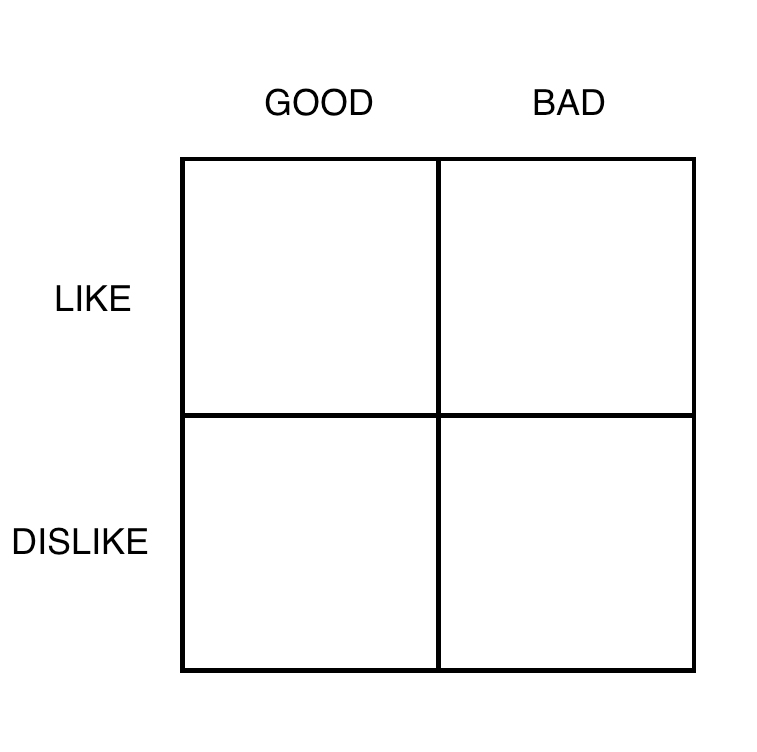
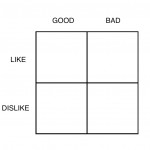 Good and bad, is not the same as what you like or don’t like. You must shatter the idea that anything you like is good, and anything you don’t is bad. If you can’t separate your personal preferences from more abstract analysis of a kind of work, then you will rarely provide much useful feedback: criticism is not about you. It’s about the work you are viewing and the person that made it. Your personal preferences only get in the way of providing the work (and its maker or possible consumers) with useful information. Learn to see the good and respectable attributes in work you do not like: they are there if you let yourself see them. For example: a good film review should evaluate the film’s merits somewhat independently from the reviewer’s personal tastes. It should be possible to read a review about a film the reviewer didn’t like, but be inclined to see it anyway based on the observations he made about it’s content, style, and form.
- Talk as much about what it is, as what it isn’t. While it can be more efficient to focus on problems and what’s broken, rather than what’s good and working, if the creator can’t see both, there’s not much hope of their next choices being good ones. Make sure you spend as much energy helping them to see and keep the strong parts of what they’ve done as you help them see the weaker and more questionable parts.
- Try the PNP sandwich (positive negative positive): I don’t like this idea much, but I think it can be a good one (see what I did there?) for dealing with people sensitive or new to receiving criticism. The idea is simple: find a way to alternate your feedback. Find something positive, then find something negative, then find another positive thing. It’s an easy way to develop trust and help people become comfortable with hearing other people’s opinion. I don’t like it because it has a touchy-feely vibe and it can lead to pretension and insincerity. However I have seen it work as a way to get strangers to warm up to each other, and eventually grow out of this little pattern of behavior.
Receiving critical feedback
 It’s much harder to receive criticism than to give it. By the time most people make it through college there have been so many bad experiences with receiving feedback, especially on creative work, that they tend to avoid it or ignore it. Nothing can be worse: feedback is essential to developing ideas, and if the project involves a team in any way, the dialog and communication that falls out of feedback is essential. Anyone that makes anything must find ways to not only obtain feedback, but to master the skills of milking it for all it’s worth.
- Shut up. Just shut up and listen. Creators often fall into the trap of speaking for their work, trying to use words to defend things that should be in the design. This is a form of denial: The work has to speak for itself. Even if only for a few minutes, let the prototype or draft be its own thing, and stand on its own. If you respond right away to (or perhaps interrupt) every point made in a critique, you can’t possibly be thinking about what’s being said to you. Thinking takes time. Try to talk as little as possible, and let the time be used for critique, not for defense. If you don’t trust the people critiquing you to be fair, that’s a problem best solved by defining sound ground rules (See below), or by investing more in finding better critique partners.
- Ask clarifying questions. Again, avoid filling the conversation with defensive chatter. Instead, respond to questions by trying to sort out any ambiguities or points you don’t agree with by getting whoever is critiquing to restate their point. “When you say the style in my design is sloppy, do you mean that the lines aren’t sharp, or that the composition isn’t balanced quite right? Can you show me exactly what you mean?” By asking clarifying questions you allow yourself time to decide if you agree with the criticism or not by working with the other person to understand their point/question better. It makes the critique into a dialog, which is what it should be, and not a courtroom trial.
- Refer back to the goals. If you’re not getting what you want from the critique, provide some goals for the work that you’re trying to achieve. If you’re working on a project this should be easy: the goals for a given design should derive from the project goals. Ask whoever is giving you feedback to do so in terms of those goals or your derivations of them. Then whenever the conversation goes astray, you can refer back to the goals and set things in a useful direction again.
- Ask for what changes you can make that will satisfy the criticism. The goal of criticism is not to learn every nuance about a design’s weaknesses: its to know enough about a design so that the designer can make it better. If you agree with a criticism, but don’t see a path to improvement, ask for one. Turn the question back around on the person who made the comment. “Good point. So do you see anything I can do to improve on that?” Often they won’t have anything to say: critiquing is not the same as creating. But by asking the question you do move the conversation forward into thinking about future action, instead of staying stuck in criticism mode.
Ground Rules
- Take control of your feedback process. Feedback is not something that happens to you: it should be something you make happen. If you wait for feedback to come to you, it tends to be less positive and supportive than if you seek it out. If you walk into someone’s office and say “hey, can I have 5 minutes of your time to look at something?” you are taking control. You put yourself in the driver’s seat of the process, and can frame and shape the criticism you get however you want. But if you wait and wait and wait until deadlines approach, you have less and less control over how feedback will be given to you. It will have more edge to it and will tend to serve others more than serve you.
- Pick your partners. Who do you get the best feedback from? It’s probably not the person who loves everything you do. If you don’t think you get good feedback from anyone, part of the problem might be you haven’t taken control of the process. Be more specific about what kinds of criticism you need, and go to people and ask for it. If you find a good source, cherish it, and reward them for it. Much of what a good mentor does is provide good, consistent, honest feedback. If you can get this from a peer or a manager find ways to cultivate and reward it. Look for people outside of your company or organization that might be willing to form a peer review group: meet once a week/month over coffee and show each other your work.
- Strive to hear it all, informally and early. The sooner you hear a question or criticism of something you’ve created, the greater your ability to do something about it before it’s finished. If there is any kind of formal review or feedback process (e.g. a spec review or group critique) make it your job to find out what opinions there are of what you’re doing well before it happens. This can be as simple as going to door to door and showing sketches, and asking for a few quick comments. Give yourself the opportunity to benefit early from other perspectives and think things through. But do know how much feedback you can handle: you don’t want your work driven by other people’s opinions, but you do want to give yourself the opportunity to benefit from them.
References
- How to run a design critique: sometimes critiques need to be small group discussions. Here’s a guide for how to run these meetings well.
- Mistakes Critics Make
“Anybody can become angry – that is easy, but to be angry with the right person and to the right degree and at the right time and for the right purpose, and in the right way – that is not within everybody’s power and is not easy” – Aristotle. The same applies to giving criticism, especially negative criticism – it is difficult to do right, and can be damaging if done wrong: sometimes receiving is easier even if it is painful.
Wow!!!!!! That is the best essay I have ever read. It is so important to know how to criticize. Sometimes we want to help someone by telling them they have done something wrong, in order to help them, but we do not know how to do so, and actually make the situation even worse!!!!! I totally agree that when we criticize, we need to do it without letting our ego interfere; it is the best way to help that person. Maybe we can think what we would do, if we were in that person
Very helpful
What about if the person’s work you are criticizing that person yells back at you or ignores you all together?
There is nothing worse then being ignored.
I had it happened on a youtube channel for asking a really good question about a video and my question got deleted while all the other questions were like. “Good vid” or “Keep uploading”.
I PM’ed the person and never got a reply and yes I was polite so now I am still flustered despite it being months ago.
When I get flustered I cannot let it go as it’s in me forever until I get an answer or go insane asylum crazy.
your materials are educative. keep it up please.
i wish you send materials on artistic directing to me with references
I know the taking a critique from anyones most of the time our reaccion is defensive, but when we criticise someone else we think that is easier, bad idea it is the hardest point. Thank you for your help. It is vere good.
Very helpful
i have been working as a critic forthe last ten years.usually i used my uqniue technique. mostly u prefere in this way. first itray to introduce the book, film and song in short way, the writer, contents and texts then i jump to the second phace. i tray to asses the internal part of the work, through the formal and informal literary terms. just how do ilook the work its iner part. then i describe generaly and particularly in detail, in ther third phase, the work in phsycoogicaly,sociologicaly, socio economicaly and philosophicaly. at last in the forth phase i put down my comments objectively. my custumers accept this type of critic.
I to is very difficult to everyone when somebody criticizes to be calm and think for sometime but to get success everybody must accept criticism this is very useful
Thats easy to say, when you never had a critic, that the only thing they had to say about your work, was that it was padding, but they never bothered to explain why. And then use irrelevant comparisons to pop culture icons you haven’t even heard of.
I am not sure why you don’t like the PNP method. All Critiques should be handled this way unless you have a Pro critiquing you work that you totally respect but that is not always the case. You should really focus on the positive and ask them what they think of the negative and give them choices.
There’s a 10-1 ratio between the value many creators put on positive comments vs negative ones. So when giving feedback, if you want your ‘audience’ to hear anything but the negative one, you’ll need to make it a PPPNPPPPPPP method (at least for low-trust relationships, as you point out).
In my experience giving PNP feedback the receiver tends to think you are just buttering them up while they wait for the other shoe to drop. It’s formulaic and can reduce the perceived integrity of the feedback.
Personally I’ve found it more helpful to start with what can be improved and follow with what works well. In my experience this allows both to be heard, and gives you and opportunity to have an open conversation about critical piece of feedback first, making them more receptive to the positive feedback that follows. They know you aren’t shying away from saying what you really think.
The main thing here, is that the critique needs to be framed as “You could consider”, and not “You should do this, this is how you do it.” I’m inclined not to listlen to a crit thats demanding.
Padding is one of my push button words, because I already write short enough as it is, most of my stories are barely even a page. I would dare say a page length summary could use more padding.
it is very useful! it’s hard to critic someone. and if you dont say it clever you will get many problem, even you loss good friends, friendly colleagues and so …. thanks for your essay!
It’s also important to know whether someone *wants* a critique.
Yes that is a great , write up, take and give criticisim..
The hardest thing is actually to accept negative criticism. I remember myself in school hating my teacher because I got a C for my essay though I put so much effort in it after checking out different resources like customwritingcompany.com to do a pretty good job. Well, with time I understood that the criticism was reasonable and if I listened to my teacher I wouldn’t have many problems with writing essays in college.
Excellent article. I’ve asked my students to read it!
It was hell in art school to give criticism to others, because there were so many people who couldn’t take criticism constructively. You just say ”oh yeah, nice” and move on. I mean I still gave criticism, but you just knew the people who were too sensitive.
This is an amazing post. Thank you for sharing